Tuesday, May 30, 2023

Monkeys and squirrels—the dangers of aging

 I just finished reading Spare, Prince Harry’s fascinating memoir of his upbringing as a royal and his struggles to become a person in his own right. The book is an honest account (as much as I can tell) without an unnecessary trashing of the royal family. It presents the royals as human beings pressured by the unhuman expectations laid on British royalty. I enjoyed reading his side of the story, although I know there are other sides yet to be aired.

The section I want to highlight here concerns Harry’s experience in the British military, where he was deployed to the war zones of Afghanistan. Part of his training was as a helicopter pilot, a training that is rigorous and time-consuming. He describes the particular difficulty of mastering the art of hovering. He learned that the two dangers that threaten the ability to stabilize a hovering helicopter are the “hover monkeys” and the “head squirrels.”

In his own words,

… flying the helicopter, I learned, wasn’t the hard part. Hovering was. At least six long lessons were devoted to this one task, which sounded easy at first and quickly came to seem impossible. In fact, the more you practiced hovering, the more impossible it seemed.

The main reason was a phenomenon called “hover monkeys.” Just above the ground a helicopter falls prey to a fiendish confluence of factors: air flow, downdraft, gravity. First it wobbles, then it rocks, then it pitches and yaws—as if invisible monkeys are hanging from both its sides, yanking. To land the helicopter you have to shake off those hover monkeys, and the only way to do that is by … ignoring them. [p. 165]


       Hover monkeys threaten the helicopter from the outside. The other danger comes from inside the pilot’s brain: the head squirrels. A novice pilot needs to learn to fly a helicopter, not just technically, but tactically. He needs to learn to multitask—read a map, locate a target, talk on the radio, fire missiles, and pee into a bag, sometime simultaneously. The head squirrels romping inside the brain—fears, emotions, memories, a girl friend back home—“are the ancient enemies of human concentration,” Harry was told by the instructor. He concluded that what he needed was “a massive neuro-reengineering” in his brain. “The only way to get rid of head squirrels” his instructor went on, is “iron discipline. A helicopter is easily mastered, but the head takes more time and more patience.” [p. 169]

Here I am, again, pulling metaphors out of the air (or, in this case, out of a book). I am seeing that monkeys and squirrels are two dangers we face in the process of growing older, one danger coming from the outside and one from in our heads.

The monkeys are real. It’s not easy growing old. (Pardon the cliché.) Our bodies really are on a downhill trajectory. Ask anyone with a bad back if it’s real or not. Around us friends and family members are dying, and any more, they’re not those older than us; they’re our peers. We face the inevitability of our own death, perhaps preceded by mental debilitation.

In addition to the losses of health and loved ones, we face the loss of livelihood, of stuff, of the family home, of the energy to travel and have adventures, of the ability to be productive and contribute, of a sense of significance, and so on. Sorry to be so negative. But the monkeys are real.

The mind squirrels are our reactions to all of the above. I’ve noticed, as I’m sure you have too, that different people respond in different ways. Some face the realities of aging with determination to live a meaningful life right to the end. Others moan, whine, and pine away, or at least approach that dark road. I suppose we’re all tempted. Facing the mind squirrels has to do with attitude, of course, with intentionality and determination. And with taking practical steps to ensure that this time of life is also one of growth.

I’m going to stop writing this stuff now, lest the blog sink into an advice column. Besides most of you have thought about this, and there are excellent resources to help us with the monkeys and the squirrels (for example, Joan Chittister’s optimistic book, The Gift of Years).

I need to confess where this metaphor breaks down, as most metaphors do. It’s the idea of this time of life as a hovering. Between what and what? Between life and death? Between health and decay? Between purpose and futility? No! I disagree. We’re not hovering at all. We’re living. We’re here and the time is now.

The same choice that God gave to the children of Israel as they were about to enter the promised land, that choice he gives to us today.

This day I call the heavens and the earth as witnesses … that I have set before you life and death, blessings and curses. Now choose life, so that you and your children may live and that you may love the Lord your God, listen to his voice, and hold fast to him. For the Lord is your life…. [Deuteronomy 30:19-20]

It’s a choice God gives to all his people, no matter their age. So, in a sense, we all hover, but our choices determine the outcome.

Well, I said I wouldn’t give advice. Also, I’m known to hate easy answers. But here I am, about to offer you wise (or otherwise) counsel in the form of an easy answer. Are you ready? Here it is:

Tame the monkeys and stop feeding the squirrels.

I wonder if Prince Harry, though still young, might agree with me.


Tuesday, May 23, 2023

On being spaghettified

 A week ago I watched a PBS news feature on some of the latest discoveries in astrophysics. Science journals have reported on a star swallowing a planet. At least that’s the tentative theory of what was observed from the mega-telescopes. The commentator explained that when stars get older, they get bigger and sometimes will gobble up the planets closest to them. Our sun will do this first to Mercury and Venus. It’s far enough in the future that Earth has time to prepare, we were told.

And then when stars get old enough, they die and in the process can get sucked up into a black hole.


Every galaxy apparently has its own black hole. The commentator defined the black hole as a deep well of gravity that pulls objects, like stars, into it. Sometimes the gravitational pull is so rapid that it stretches the star out like a long thread of spaghetti. This is known in astrophysics as spaghettification.

Although I don’t understand the physics of it, the words are delightful. The black hole spaghettifies the star. The star is, therefore, spaghettified. It’s known as death by spaghettification. Poor star.

The universe is a scary place.

This amazing gem from physics yields another metaphor. Of course.

I think I’ve been spaghettified. Amazingly enough, I’ve survived, but the experience serves me as a lesson and a warning.

In spite of my intention of flowing into a peaceful and gently fruitful old age, in the last month I let myself be stretched thin by too many commitments and activities. I gave three public poetry readings, something I enjoy doing occasionally. I led two large worship gatherings, and gave leadership to several small groups. This in addition to my normal editing responsibilities and writing deadlines.

Groups, noise, and motion trigger my vestibular migraines, so I ended up spinning, nauseous, and exhausted most of the time. Stretched out beyond comfort. Spaghettified.

This week the calendar is refreshingly free. I’m still panting but I expect peace to descend. I’m sitting and breathing, reading a good book, and praying my way back to normality (which is something I’ve never been able to define).

So, have I learned my lesson? Will I heed the warning? Maybe. At least somewhat. But I suspect this is a situation I will continue to face, a lesson I will continue to learn. It’s partly coming to terms with the reality of aging. It may be a cliché to note that I can’t do what I used to do as fast as I used to do it. But cliches can be true.

Are you listening, Nancy?

St. Paul himself experienced aging and overextension. The man was a workaholic up to his death (though it was not through a black hole). But he penned these encouraging words: “… we do not lose heart. Though outwardly we are wasting away, yet inwardly we are being renewed day by day” (2 Corinthians 4:16).

Can I permit myself the possible heresy of a paraphrase? As usual, yes. Here goes: “Though outwardly I am being spaghettified, inwardly the sun is shining on a beautiful new day.”

The challenge is to avoid the outward spaghettification while inwardly living into the beautiful new day, sponsored by the One who makes all things new (2 Corinthians 5:17). Even old people.

May the Force be with you.

Tuesday, May 16, 2023

Twisted hands, cheerful heart

 Yesterday we celebrated Mother’s Day with a barbecue at my son’s home. At the end of the meal, David asked everyone to give a memory of their mother, and we went around the table. David said some nice things about me. Hal reminisced about his mom… and so on. When my turn came up the only thing that popped into my head was the interesting coincidence that that very day, May 14, was also my mother’s birthday. How amazing, right? Everyone said their own version of Wow! and we went on to the next subject.

Later I wondered why I hadn’t said something more significant about this woman I remember with so much gratitude. Something about her kindness, her simple meals, how she read books to us every night, how she sewed my Easter dress one year and bought me a bonnet and shiny patent leather shoes to go with it. Actually, this is all rather normal. Not especially interesting. Nothing funny or extraordinary. Just common ordinary grace.

But what’s wrong with that?

OK. If there’s one thing that stands out in my memories of Mom, it’s her hands. When I was in grade school, the swelling and pain in her feet and hands were finally diagnosed as rheumatoid arthritis. My parents didn’t make a big deal about the diagnosis, so there was no family trauma surrounding it. Mom began to take medications for the pain and inflammation, but she never talked about it or complained. She just kept on doing mom stuff and going off to work everyday.

Both my parents were public school teachers, Dad in the high school and Mom in primary school. Mom continued teaching, but I noticed the swelling in her hands and that it was becoming harder for her to do stuff around the house. We kids had our chores, but we didn’t always cheerfully comply.


By the time I was a high school freshman, her hands and feet had become bent, swollen and deformed. She was declared legally disabled and began to receive disability compensation from the teachers’ union. My parents handled this calmly so we kids saw no reason to be alarmed. Life went on. She became a stay-at-home mom again, going about her duties with a cheerful spirit

But with the years her limbs became more and more twisted and her whole body was affected in different ways. She died at the age of 57, more from the effects of years of taking Corticosteroids for the pain than from the disease itself.

Sometime after her death, I was doing research on my family background, and I came across a kind of manifesto Mom had written when she was 17. It’s entitled, “My Ideal Woman,” and is a list of all the characteristics she wanted to grow into. In the introduction, she admits that, “My Ideal Woman is so idealistic as to be rather fictional sounding.” A list of 14 points follows, betraying both the idealism and the immaturity of a teenager. What was especially poignant to me was that the first two points had to do with hands. She wrote of her “ideal woman,”

1.     She does not have to excel in outward beauty but must show character in the mold of her face and in the shape of her hands.

2.     Her hands are shapely and she has well-kept nails.

It’s a mercy she couldn’t see ahead to the hands life finally dealt her.

I will list a few other of her points. They all make me smile.

6.      She does not think of ‘self’ first and is cheerful except when it is impossible to be so. (A little bit of realism there.)

7.      All of her clothes are made by her own hands (except for wraps, accessories, and undergarments). (So glad for the clarification.)

8.      She is healthy and has suffered no illnesses save those common to most people such as measles and mumps.

9.      She scorns gossip and secretly is contemptuous of those who do so extensively.

1      She has poise and a wonderful personality, making her very popular.

She goes on to write of her tall husband (right) and two blond children (wrong, there were three of us), her artistic output, and her excelling at sports (especially golf, swimming, and tennis). She ends with saying that her ideal woman “is somewhat like Abraham Lincoln and Louisa Alcott only she doesn’t have Louisa’s temper or impatience.”

Oh, and she also mentions that her ideal woman is a Quaker.

Life certainly turned out differently for my mother than her dreams as a young girl. But I think I like the real woman better than the ideal. God made something beautiful out of her suffering, and I am the better for it.

I don’t want to fall into cliché here—“my sainted mother” and all that. She was real and human, feisty sometimes, sometimes manifesting more Louisa Alcott than Abraham Lincoln. And I don’t want to romanticize the beauty of her old gnarled hands. Too many sappy poems and Hallmark cards take on that role. They tend to nauseate rather than inspire.

But I’ll admit it. In memory, my mother’s hands are beautiful to me.

Now that I’m growing older, I find that it’s my hands that show my age more than any other physical aspect. I used to pride myself on my beautiful hands (somewhat like my 17-year-old mother). People sometimes complemented me. No one does that any more. The seven top signs of aging in hands are wrinkles, age or sun spots, dry skin, loose skin, veins, stained and brittle nails, and red peeling skin. The only thing on the list I don’t have (yet) is red peeling skin.

Look up “aging hands” on the internet and most of the sites address the topic of how to keep your hands looking young. Lots of good advice out there, most of it dedicated to postponing the inevitable.

I am faced with the decision to choose a mature perspective on aging hands and beauty. I’ll do what I can to protect my skin—gloves when washing dishes (which I never did as a younger woman), lotion, good grooming and so on. I probably won’t try any miracle pills or expensive dream creams. I’ll let myself—and my hands—grow older and not worry about how attractive, or not, they are.

And I’ll hope my daughter and granddaughters find some good ways to remember me on Mother’s Day.


Tuesday, May 9, 2023

My old face

 It was a small interaction with a small child, and it happened several years ago, but it seems even more relevant today.

One afternoon as Hal was taking our bicycles out of the garage, a woman pushing a stroller stopped and asked for directions to the nearest park. Two other kids ran around the stroller, while the baby eyed Hal suspiciously. The woman was new in town, and the kids obviously needed somewhere to express their energy. Inspired, Hal told her that he and I were just about to go bike riding, and why didn’t we all go together to the park. 

I came out, met our new neighbors, and off we went.  It turns out that the woman had just moved in with her boyfriend, and that the kids were his grandchildren.  I expressed surprise; she hardly looked old enough to be their mother’s age.

I was glad we accompanied them, as one part of the route had us walking a narrow sidewalk down a busy avenue, and the kids were glad to be out doors and on the loose. We made it safely to the park and spent the rest of the afternoon together. Hal and I bonded with the two older kids as we rode bikes together and played on the swings. The baby, however, never stopped scowling at us.


Near the end of the afternoon, four-year-old Anabel, looked at me sweetly, head cocked to one side, and asked, “Why is your face so old?”

I wasn’t prepared for that. I don’t remember how I responded. I probably just laughed. But the question circled in my mind for weeks afterward. Actually, it made me chuckle. But it also forced me to examine my values, especially in light of a strong cultural pressure to look as good and as young as possible.

I’ve been feeling that pressure ever since I was 13 years old, although for a while I wanted to look older than my age. As I grew up, married, and raised my children, my experience for many years was that of my new neighbor. I’ve taken pride in all the times people have said things like, “That’s impossible! You look too young to have kids that old!” Or, “You? A grandmother? You certainly don’t look it.”

As I entered my 60s and qualified for the senior discount at the grocery store, I was delighted when the clerk would ask to see my identity. That hasn’t happened in a long time. Now I’m sort of disappointed when a clerk doesn’t ask to see my driver’s license. For some reason being taken for younger than I am affirms my value as a person.

Looks still matter, even in the autumn years. Do they matter too much to me? On some days, not so much. Some days I can relax and enjoy the people I’m with without fussing about my clothes or my old face. But other days, I worry about whether my wardrobe is adequate to hide my tummy. I won’t wear sleeveless shirts because my arms jiggle. I avoid the mirror. A black cloud of discouragement descends.

Is this silly? Am I really so immature? Probably yes to both. But there’s hope.

I remember when I was younger how at different points in my life God sent an older woman to befriend and mentor me. There were three of them, each coming alongside me in a different decade of my life. Bess, Catherine, and Inez. We shared our secrets, talked about marriage, child-raising, living in another culture, writing, and following Jesus. I loved listening to their stories and they encouraged me to talk about my struggles and joys. I learned through who they were as well as what they had to say.

They all probably had old faces and jiggly arms, but I didn’t notice. I saw each one of them as beautiful because they were. I began to pray that, in the right time, God would make me into a beautiful old lady, too.

That kind of beauty has nothing to do with the lack of facial wrinkles, loose flesh, or clothes that don’t disguise your flaws.

I need to remind myself of this because it’s easy to let the values of this youth culture make me dissatisfied with my looks. Stop, it, Nancy! Sometimes I listen to myself. Sometimes I don’t. But I look around me in this community and see a good number of beautiful old ladies. They encourage me to realign my values and see the Reality behind the realities.

To see the beauty in old faces.


(Note: Did you notice the face in the old tree photo? Actually he's an ent who lives in Hess Creek Canyon and a good friend of mine.)

Tuesday, May 2, 2023

Eye contact

Being retired and growing older are hard and I don’t always do them well. But this is not the only time of life with its challenges. My grandchildren remind me frequently that it’s not easy being a kid. And being a “special” kid adds to the drama.

My grandson, Peter, has autism. He is bright, creative, quirky, and full of interesting and unusual perspectives on life. He has attended regular classrooms in public school all this life (it’s called “mainstreaming”), and has excelled, especially in math and computers. He is now 14 years-old and our go-to person when we need help with technology.

While the academic stuff comes easy to him, he has struggled with the social side of life. He now has his circle of friends, which he isn’t interested in expanding. (He once told me, “I’m glad I’m not popular ‘cause then I’d have to talk to all those people.”) Acquiring social skills has been a learning curve.

I remember when he was in the second grade, facing his end-of-the-year assignment. Each student was to give a three-minute public speech, telling the rest of the class something about themselves. They were to write out and practice their speech ahead of time. They could use their manuscript as they spoke.


Peter was one of those rare children who actually loved to write. At one point he wanted to be a writer when he grew up and by eight-years-old had written and illustrated over 20 “books.” (Now his ambition is to do something amazing with computers.)

So, producing the manuscript for the speech offered no problem.

The difficulty came with the other guidelines, chief among which was eye contact. Peter was supposed to look around at people as he spoke. He was instructed to make contact with his audience of second grade peers. He would be graded on this.

Eye contact has been problematic for Peter since infancy; it’s part of autism. He’s actually done quite well and has learned to look people in the eye as he speaks with them. But it’s never become quite natural.

And he doesn’t multitask. Give him a job to do, with clear instructions, and he can pour himself into it with passion. But giving a speech and making eye contact with an audience are two separate tasks for him, and one task too many for it to be easy or natural.

But Peter determined to get it right, so he and his mom came up with a plan. Kristin, my daughter, penciled dots in his manuscript, one after each two sentences. The dot was a clue for Peter to lower his manuscript and look at someone in the audience. They decided on five seconds as a good amount of time for the look. Then they practiced. And Kristin videoed the practices on her phone so they could learn from them.

That seems like a lot of work for the second grade.

Peter is also visually impaired, so he had to hold the manuscript close, right in front of his face. Although he had the speech memorized, he wanted to do it this way. After all, the teacher said to use the manuscript.

So, face well hidden, he stood and began to loudly, clearly read his speech. Then, briskly he lowered his arms and stared straight ahead, in this case at Kristin. When Peter stares, it’s serious. It’s fierce, concentrated and without the blink of an eye. As I watched the video, I could imagine him mentally counting to five. Then up went the manuscript and he loudly read the next two sentences. He reminded me of a robot as he again lowered the manuscript, shifted his head to stare at another person for five fierce seconds. Then up again for the next part. Repeat, repeat, repeat, right to the end. Kristin admirably harnessed her temptation to laugh.

As I said, he was determined to get it right.

And he must have done so, because he passed into the third grade.

Maybe the end product wasn’t quite natural, but I admired his determination and perseverance. I pray that life, mainly other people, will be kind to Peter—whether he avoids eye contact with them, or stares with ferocity. And I pray they listen to what he has to say.

Remembering this gives me courage for my more grown-up challenges. I don’t have a prepared manuscript to help me know what comes next in this phase of life, but I can apply determination, perseverance, and as much wisdom as I can garner from those who have gone before me.


In the early morning hours, I try to make eye contact with God. I confess that it is neither natural nor easy. Sometimes I use guidelines developed by others who’ve learned to do it well. Under their instructions, I may practice a certain number of seconds of concentrated gazing at the sky out my window. Then down again for a quick dip in the Scriptures. Up again to gaze (or meditate, if that’s the right word). Repeat, repeat.

I wonder if I look to God a bit like Peter. I wonder if I have some form of spiritual autism.

At any rate, I sense great patience and kindness coming to me from God’s heart.

And, yes, an occasional chuckle.

Tuesday, April 25, 2023

A visit to the cemetery

We got a shock the other day. The sexton of the cemetery had just informed us that our memorial space on the wall had been engraved (leaving out the years of our deaths) and was ready for us to see. We both felt a little weird about going to visit it, but curiosity won out. When we arrived, we discovered that our engraving was larger than we had envisioned. In fact, it was way too big, especially compared to all the other modest engravings on the walls. We were surprised and embarrassed.


But let me back up. For the past several months we’ve been doing our death-work. We’ve been making the decisions about things like resuscitation, pro-longing (or not) of life, what to do with our bodies, which cemetery to use, and so on. We’ve been filling out the forms, gathering and filing documents, making cost comparisons (and discovering what a big business death has become!).

We had put this off long enough. Still, we don’t feel old enough, as though we’re subconsciously thinking that our deaths will only come in very old age. We know, of course, that’s not necessarily true, but making all the arrangements seems like a capitulation to the inevitable.

But really, it’s just being responsible. It’s getting our ducks in in a row before they jump into the dark lake. And we’re doing it for our kids and grandkids so that they won’t be burdened with the decisions and details. Someday they’ll thank us. (Where have I heard that before?)

Our retirement community has recently been hosting seminars on “Facing the Hard Questions.” In three well-attended sessions, we’re receiving practical information about all these issues, complete with lists of decisions and actions, copies of the necessary forms, ideas for memorial service pre-planning, reflections on how to dispose of our stuff without causing family trauma, and so on. It’s been a helpful reminder that we need to do all of this sooner than later.

Last month we made our cremation arrangements. That really felt weird. But there’s a certain satisfaction in urging that duck into the row. We chose the Friends Cemetery, partly because Hal’s grandparents, aunts and uncles, and parents are buried there. We decided against burying an urn in the ground with a plaque above it, choosing instead to include our names in the wall of engravings. We took our time deciding on what to put on it, wanting a verse to accompany our names.


Back to the visit to the cemetery and the viewing of our engraving. Its size reflected a misunderstanding that seemed huge. It outflanked all the other engravings on the wall and seemed to be bragging, “These dead people are grander than all those other dead people!” But that’s not at all what we think. The opposite. We’ve always felt that small is better than big, modesty better than pride. A whisper is stronger than a shout. But with this engraving, we seem to be giving a big proud shout. So embarrassing.

Surely, we hadn’t ordered this size engraving. But, on second thought…maybe we did. Inadvertently. My borderline dyslexia confuses distance, dimension, and size.

Then, after the emotions subsided (helped by slow breathing and time), my third thought was simply, “So what?” Will anyone even notice? It’s not that obvious (is it?) and people coming to a cemetery aren’t really in a mood to judge other people’s dead relatives.

This led me to ponder the purposes of memorials, be they tombstones, plaques laid in the grass, engravings on a wall—or even the Taj Mahal! We all want to be remembered, and this is, in part, an attempt to make that happen. We need to leave behind a testimony that we existed, breathed, walked on this earth, and lived out a story. We hope they visit “us” with gratitude and good memories.

I visited the Vietnam Memorial several years ago and was profoundly moved by the beauty and simplicity of thousands of names engraved on the curving black wall. The arrangement of the names, all the same size, inspired reverence and gratitude for the young men and women who gave their lives. Even for those of us who did not support the war, this memorial seems appropriate. It serves a good and necessary purpose.

And, of course, another key purpose for a memorial site is to provide a place where our friends and family can come to remember us and celebrate our lives. But I have to ask myself,  will our kids and grandkids and friends really visit, after the death rites are over and done? My parents are buried in a small site in Fallbrook, California. It’s far from my home and I’ve only visited it once; but I think of them frequently, with gratitude. I trust the memories we’ve created with our kids and grandkids are stronger than granite. Even so, I’m glad I have my name on that wall. For them.

I realize that probably pride is driving my embarrassment at the size of our engraving. I don’t want other people to judge us arrogant or self-promoting. Which is silly. We know we are not that way. More importantly, God knows.

We think we’ll just leave it. Not that we have much choice. Erase an engraving in granite? Hal suggested removing and replacing the whole slab. Not going to happen.

I’ve decided to rest in peace (even while staying alive). I’ve also decided I won’t go to look at it again.

Now that that’s settled, I think I’ll write my obituary. I’m going for hilarious. 

Tuesday, April 18, 2023

Stuff

 Stuff is one of my favorite words. I like the round plump way it feels in my mouth. I like the way it starts with a hiss, slowly snaking its way toward the light, only to come to an abrupt halt (we call it an alveolar stop in linguistics, in case you wanted to know), then ending in a slow flat leak of carbon dioxide (a labio-dental fricative). There’s a lot going on in your mouth when you say the “simple” word stuff.

But more than the sound and feel of the word, I like what it means and, more importantly, how it means.

As with many words that appear simple, time spent in the Oxford English Dictionary quickly dispels that illusion. The noun stuff can mean a variety of things from supplies and possessions to textiles suitable for clothing, and even academic subject matter, as in “This teacher really knows his stuff.” It can mean something lofty, a fundamental substance, such as “the stuff of greatness.” Or it can be as specialized as the spin on a fast flying baseball (a new one to me). And, of course, we also have many verb meanings, derivatives (some very edible), and even a few expletives (among which “O stuff and bother!” is the safest for Quakers to use).

There’s a lot of “what” to the word stuff, but the “how” is perhaps more significant. Stuff, in short, is not a reverent word. It is not likely to ever be incorporated into a liturgical prayer, carved onto a memorial plaque, or sung at a wedding. It struts down the halls with a casual, cocky air. Look closely and you’ll see a twinkle in its eye. It’s crossing its fingers behind its back.


Let’s consider stuff in the sense of personal property or possessions. “Hands off! This is my stuff!”

It’s precisely because of the irreverent casual feel of this word that I like to apply it to my possessions. In my heart of hearts, I find myself attached to my stuff in a most unholy way. When someone threatens to take what belongs to me, my emotions flare up. I can become very distressed at breaking some valued pot. Little kids running through my rooms unnerve me.

Labeling my things as stuff helps me put them in perspective. I desire to become less and less possessed by my possessions, freer to value what’s really valuable (like little kids).

As missionaries in Bolivia, we stored our stuff in big barrels every time we came back to the States on furlough. These barrels had to be properly labeled in case something happened to us and the remaining mission staff had to sort, send, or sell our possessions. One time, in a fit of whimsy, I labeled our barrels “General Stuff,” “Specific Stuff,” “Favorite Stuff,” and “Stuff I could get along without if I had to but would prefer to keep if it’s all the same to whoever is reading this label.” (That one took five labels!) Fortunately, nothing happened to us.)


I have this recurring Walter-Mitty-type daydream where my house and all my possessions burn down, but we escape unharmed. I remain calm and spiritual throughout the ordeal. When someone, dripping with pity, says to me, “I hear you were wiped out by the fire,” I reply, serenely and cheerfully, “Oh no, I’m still here, as good as ever. Just my stuff got burned.”

In my saner moments I laugh at that daydream. I know that a real fire would devastate me, that I would lose not only my “General Stuff,” but also my family photos, the teddy-bear my daughter bought me, my great grandmother’s wedding dress, the stories the kids wrote when they were little, and other things I deeply value. I would need help in dealing with loss. This is reality.

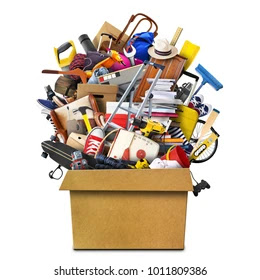
Now in my retirement years, downsizing is an ongoing assignment. We simply don’t have the space for a lot of books, nick-nacks, cookware, extra sheets and blankets, and on and on it goes. We don’t want to leave a lot of these decisions to our kids (who, actually, would probably find it easier to dispose of our stuff). So we continue to shrink, both in terms of our bodies and our possessions. It’s not easy.


John Woolman inspires me to put my possessions in perspective. I am especially drawn to the story in his journal about his growing retail business and his struggle with the “stuff and bother” of material success. He finally concludes that “Truth required me to live more free from outward cumbers,” and simplifies his business so that he can give himself to traveling and encouraging his brothers and sisters in the Quaker family. Cumbers is another good word for stuff.

Jesus reminds us that God knows our need of adequate shelter, clothing, and food. Our Father is generous. We are to seek first his kingdom and righteousness, and he will supply all the stuff we really need (Matthew 6:33, Thomas version).

I need to be frequently reminded of this. I’m still far from John Woolman’s courageous act of throwing it all off. I’m still cumbered by more stuff than I need. But the desire for freedom and simplicity is growing. I pray God will help me to hold my possessions more lightly, and to know that, no matter how pretty, bright, or enticing, when all is said and done—it’s just stuff.

--Adapted from an essay published in The Evangelical Friend, 1992.